About
As part of the new housing policy for the DTES in part 1, there is also a heritage policy for the heritage buildings in the Downtown Eastside/Oppenheimer District (DEOD) and Thornton Park subareas. The housing policy introduces a new Heritage Framework with the rationale that the existing process for heritage buildings in the area will slow down necessary housing development. Criteria for that framework included historic, cultural and architectural significance, efficacy of current use and purpose, physical condition, upgrade history, and development potential.
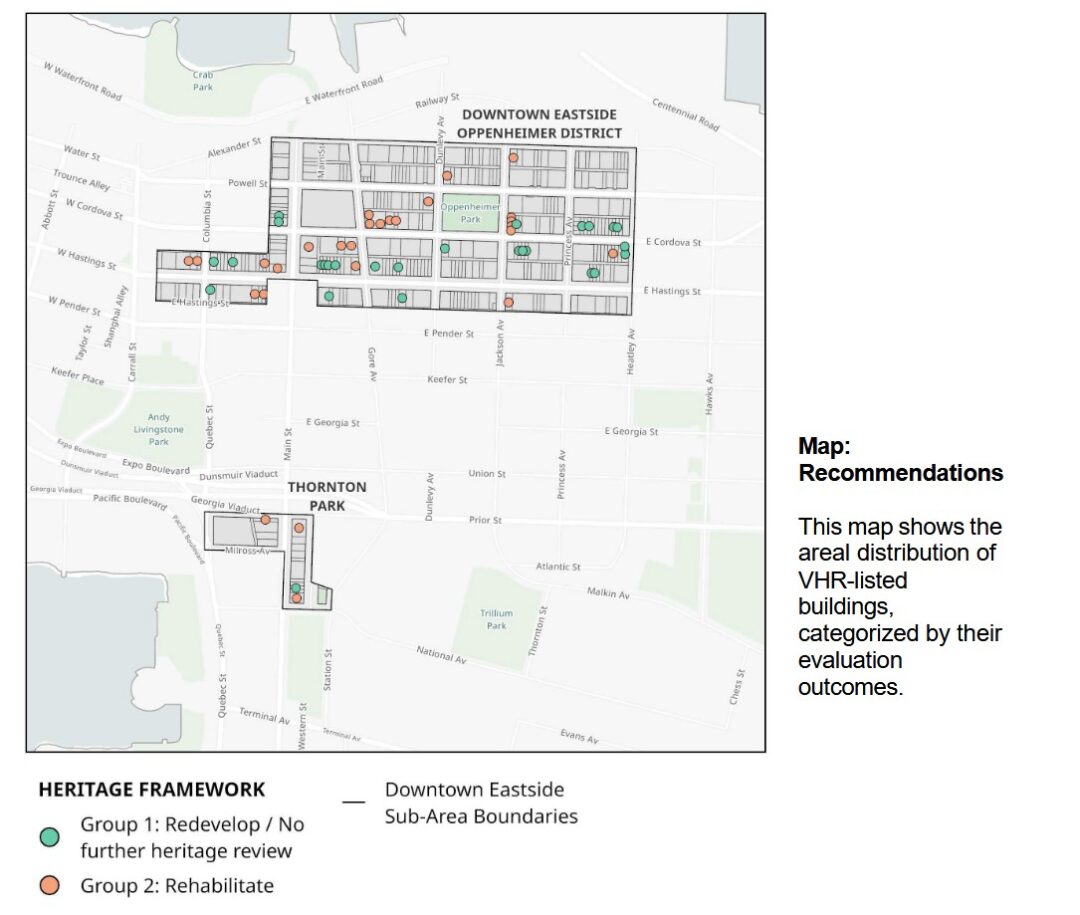
Within the Downtown Eastside/Oppenheimer District (DEOD) and Thornton Park subareas, there are 54 sites listed on the Vancouver Heritage Register (VHR). Of those 54 sites, 17 are Single Room Occupancy (SRO) buildings.
To streamline the redevelopment process and accelerate the replacement of SRO buildings, City staff pre-reviewed the 54 VHR-listed buildings and categorized them into two groups with 27 buildings each. Staff named the first group “Redevelop” with the intention of them being replaced because of significant deterioration and substandard functionality. Staff named the second group “Rehabilitate” giving the reasoning that those 27 buildings are prioritized for retention due to heritage value, physical condition, existing legal protection, or limited redevelopment potential.
Twelve of the buildings on the “Rehabilitate” list already have municipal protection. Normally, the buildings on the heritage register are flagged for review when any development applications are submitted to the City. Staff evaluate the application, review the building and discuss with the applicant possibilities for retention. With the new framework, the 27 “Redevelop” buildings have been pre-reviewed so that if there is an application to develop on the site, City staff will no longer carry out the review process and discussions about retention. For the “Rehabilitate” buildings, they will just continue to be reviewed if there is an application. There are no initiatives or funding programs for rehabilitation accompanying this creation of the “Rehabilitate” list. Further, being on the “Rehabilitate” list does not mean they cannot be redeveloped, they just go through the process of review.
The Vancouver Heritage Commission offered conditional support agreeing with reducing review requirements where appropriate as a way to support the development of new affordable housing. However, the Commission also provided recommendations to reclassify some buildings to the “Rehabilitate” group and for sensitive treatment of Paeru-Gai (Japantown).
Why on the Top10
The public hearing and the new policy proposals show different ways of how heritage is understood, and how it is and is not executed in policy. In addition to the perspective of heritage as building preservation (the built environment), there is the perspective of heritage in the form of sustaining how a neighbourhood works and peoples’ relationships to a place (the entire human environment including the buildings)- a point that we made in Part 1. This was how many DTES residents and groups talked about the neighbourhood, its people, community assets, buildings and history.
Heritage as an Ecosystem
In the engagement summary and during the public hearing, many residents and those working in the DTES expressed heritage as their socially integrated communities and ties to people and places. Longstanding businesses like Sunrise Market and the Ovaltine Cafe play very important and sometimes multiple roles in the lives of residents. They also expressed the importance of protecting SRO buildings as housing. There will be a severe shortage of replacement housing if the SROs are demolished and groups of people who have built up a network of support for each other will be separated. For them, a historic SRO building like the Empress Hotel is tied to their survival and the passing of the rezoning policies may result in the fears they communicated to the City about displacement and even more hardship.
Built Heritage
Regarding the 54 properties on the heritage register, the reasoning for splitting them into “redevelop” and “rehabilitate” appears to be more about accommodating the future consolidation of property lots. The reasoning for splitting them into “redevelop” and “rehabilitate” does not always appear consistent. For example sites which have gone through comprehensive renovation and restoration, seismic upgrade and repurposed for housing, social services and social enterprises such as the Hazelwood Hotel and the Irving Hotel have been moved to the “Redevelop” list.
Social and Cultural aspects of Heritage
None of the recommendations made by the Vancouver Heritage Commission were adopted in the Council policy report. Those recommendations pointed out buildings that have important cultural and social value such as the Afton Hotel (home of the Ovaltine Cafe) and the Chapel Arts building or are meaningful to equity denied groups such as Chinese and Japanese Canadians.
As stated in Part 1, this work on housing policy in the DTES would have been an opportune time for the City to have applied the Historic Urban Landscape approach, which is a pillar of the City of Vancouver Heritage Program. Although Historic Urban Landscape may sound esoteric and only for planners or academics, it actually has important relevance for a range of social and cultural issues, especially those concerning neighbourhood social fabric because it focuses on planning for the entire human environment of an area.
We acknowledge the financial assistance of the Province of British Columbia