About
The Downtown Eastside (DTES) stands as one of Vancouver’s oldest, most diverse, and most profoundly challenged communities. A neighbourhood of stark contrasts, it is simultaneously a repository of the city’s history, a centre of vibrant cultural life, and home to a deeply vulnerable population grappling with poverty, homelessness, and addiction.
In 2014, the City of Vancouver released a comprehensive draft Local Area Plan (LAP) to guide the evolution of this vital community over the next 30 years. According to the DTES LAP, the community’s profile is defined by several key characteristics including
- Historic Significance: deep cultural importance for numerous communities, including Indigenous, including those of Chinese-Canadian and Japanese-Canadian heritage, whose histories in the area have been marked by both profound contribution and injustice.
- Economic Disparity: The economic divide between the DTES and the rest of the city is stark. In 2006, the median household income was just $13,691, compared to the Vancouver city-wide median of $47,299. More than half of the area’s residents are poor and dependent on income assistance, pensions, and social services.
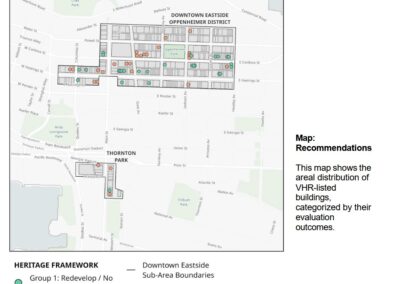
- Distinct Neighbourhoods: The DTES is a “Community of Neighbourhoods,” a collection of seven distinct sub-areas, each with its own character: Chinatown, Gastown, the Industrial Area, the Oppenheimer District, Strathcona, Thornton Park, and Victory Square.
Summary of New Policy
There is currently a complex and contentious set of policy changes approved by City Council on December 16, 2025. The City of Vancouver will significantly overhaul its housing policies for the Downtown Eastside (DTES), a move prompted by the perceived failures of the 2014 DTES Plan. The new plan includes:
- Inclusionary Housing Ratio:A significant inversion of the previous policy, the proposed ratio for new mixed-use buildings in the DEOD would shift from 60% social and 40% market rental to 20% social and 80% market rental.
- Change in Social Housing Definition:The affordability requirements for social housing projects would be modified. The current mandate for a minimum of 33% of units to be rented at the shelter rate would be reduced to a minimum of 20% of units at the shelter rate.
- Below-Market Rental Model:A new tool would be introduced to allow privately owned below-market rental housing in the DEOD and Thornton Park. In exchange for increased density, these projects would be required to provide 10% of units at deeply discounted rents ($809/month for a studio unit).
- Increased Density:To support the financial viability of SRO replacement and new housing models, the changes allow for significant increases in building height and density, reaching up to 32 stories in some areas.
- Streamlined Development:The plan aims to accelerate the replacement of aging SROs through a combination of City-initiated rezoning, new heritage processes designed to reduce review requirements, and the relaxation of certain SRO replacement policies.
The City views its rationale for these changes as a need to be pragmatic: while the new policies reduce the affordability requirements on individual projects, they are designed to improve overall financial viability for development. This pivot from deep affordability mandates to market-driven incentives has ignited significant political and public debate.
Impact of this new project on the community
The proposal had been the focus of significant media attention and public controversy. The most significant finding from the official community engagement process was widespread and deeply felt apprehension. Across nearly all resident engagement sessions and survey responses a pervasive fear that the proposed changes will accelerate gentrification and lead to the mass displacement of the low-income community dominated the feedback. Residents expressed a profound mistrust of private developers and a widespread view that the plan prioritizes profit over people. The introduction of more market-rate housing is not seen as a tool for creating a “mixed-income community,” but as a catalyst for pushing existing residents out.
SRO tenants, who are among the most directly impacted by the proposals, articulated a detailed and forceful rejection of the plan. They view the existing SROs not just as housing, but as deeply interconnected communities with internal support systems that are “life-saving.” The prospect of redevelopment, particularly under the proposed new rules, is seen as a direct threat to this stability. Tenants emphasized the acute shortage of shelter-rate housing, deep mistrust in developers’ willingness to follow through on relocation protections, the critical importance of preserving internal SRO communities and neighbourhood support networks, which provide tangible and essential functions including “social support, help with daily activities and harm-reduction.”
Members of the Urban Indigenous community echoed the broader concerns about gentrification and displacement and articulated an urgent need for housing solutions that prioritize Indigenous-Led Housing, are family oriented and center on Indigenous art, culture, and design, including dedicated spaces for ceremony, gathering, and placemaking. They also emphasized the need for a relocation strategy that understands the traumatic nature of moving people, understands cultural needs and the need to provide safety, and choice.
In the engagement, private developers expressed general support for including private development options in the housing mix but emphasized that economic viability remains a major challenge despite proposed increases in height and density. They noted that lower area rents and the high cost of providing low-income housing make projects difficult to sustain without senior government funding or operating subsidies. Developers also flagged potential difficulties in renting up market units. On tenant relocation, developers highlighted a shortage of non-market units suitable for displaced tenants and expressed concern about relocating low-income residents into market rental housing.
The City of Vancouver’s Heritage Program and Historic Urban Landscape
In the update to the City of Vancouver Heritage Program in 2020, the City of Vancouver adopted the Historic Urban Landscape Approach. Historic Urban Landscape was created specifically to approach heritage in a way in which development and heritage can coexist together. The approach treats heritage as the entire human environment; it is an ecosystem holding together relationships that people have with a place including its buildings. Critical steps in the approach include gaining a comprehensive understanding of the physical resources as well as community assets, services and social networks in order to know what is valued. This is followed by an assessment of threats to these assets. Planning and development would center around these insights so that change can enhance rather than take away these assets.
Many comments from residents in the City’s own engagement summary as well as speaker testimonial at the public hearing show that these people intuitively understand this way of thinking about planning changes to an entire human environment. They have a direct understanding of how the neighbourhood works and how buildings, businesses, social networks, community services provide for their needs and they have expressed this ecology beyond individual buildings or collections of buildings, relating them to ways of living and surviving in the DTES. This would have been an excellent opportunity for the City to have applied this approach which it adopted for more holistic outcomes that encompass both tangible and intangible aspects of the DTES.
The DTES Rezoning Policy is continued in Part 2 with the Heritage Framework
Additional resources:
https://www.shapeyourcity.ca/dtes-housing
https://www.shapeyourcity.ca/dtes-housing/widgets/202767/faqs#41314
https://syc.vancouver.ca/projects/dtes-housing/dtes-housing-summary.pdf
https://globalnews.ca/news/10976443/downtown-eastside-plan-critics/
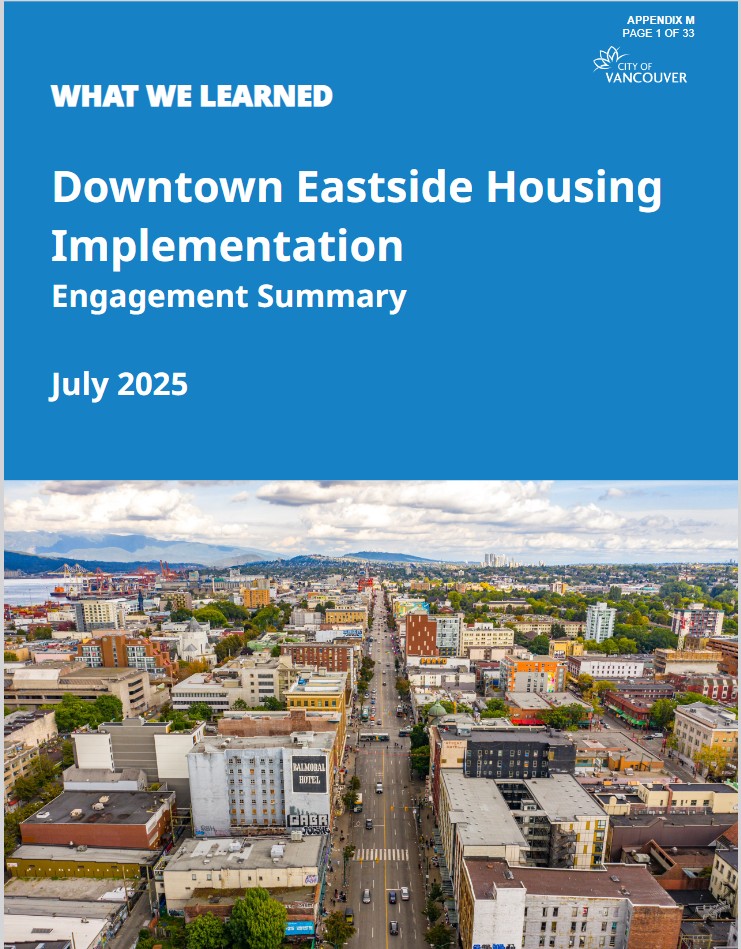
https://syc.vancouver.ca/projects/dtes-housing/dtes-housing-engagement-summary.pdf
https://vancouver.ca/files/cov/downtown-eastside-draft-local-area-plan.pdf
We acknowledge the financial assistance of the Province of British Columbia